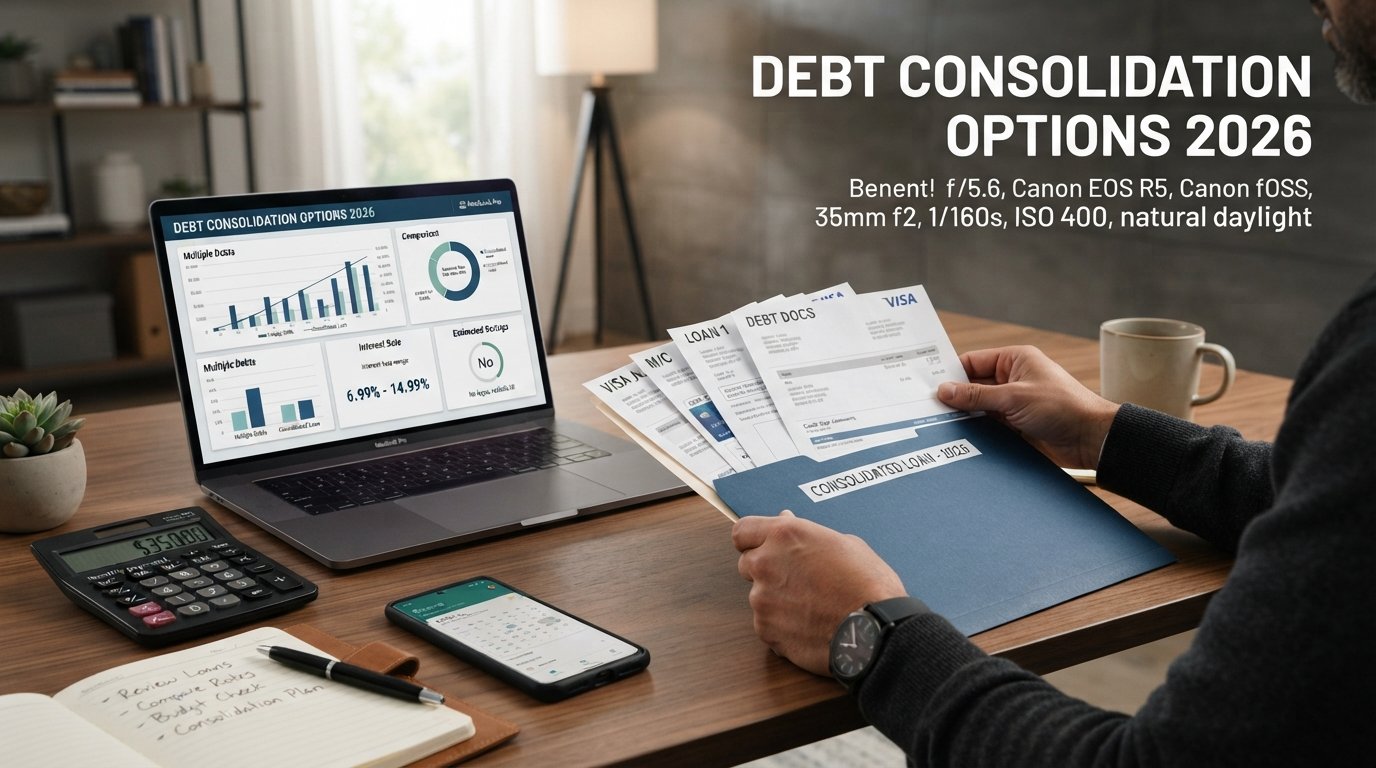
Managing multiple debts can become unnecessarily complicated. Different balances, interest rates, minimum payments, and due dates can make it difficult to see how much you are actually paying each month.
A debt consolidation loan can simplify that situation by combining multiple debts into one new loan with a single monthly payment. If the new loan has a lower interest rate than your existing debt, consolidation may also reduce your interest costs.
However, debt consolidation is not automatically a money-saving strategy. A longer repayment period, origination fees, or a high interest rate can make a consolidation loan more expensive than the debts you are replacing.
This guide explains how debt consolidation loans work in 2026, what borrowers should compare, who may benefit, and what alternatives are available.
What Is a Debt Consolidation Loan?
A debt consolidation loan is a personal loan used to pay off multiple existing debts.
For example, you might have:
- Credit card balances
- Medical bills
- Existing personal loans
- Store or retail credit balances
- Other qualifying unsecured debts
Instead of making several payments to different creditors, you use the new loan to pay those balances and then make one payment toward the consolidation loan.
The strategy works best when the new loan has favorable terms and you avoid accumulating new debt after the old balances are paid off.
How Debt Consolidation Loans Work
The process is relatively straightforward.
First, you apply for a personal loan with a bank, credit union, or online lender. The lender evaluates factors such as your credit history, income, existing debt, and other financial information.
If approved, the lender provides the loan proceeds. You then use those funds to pay your existing creditors, either yourself or through a lender’s direct-payment service when available.
Afterward, you make one monthly payment on the new loan until the balance is paid off.
For example, suppose you have:
| Debt | Balance | APR |
|---|---|---|
| Credit Card A | $4,000 | 24% |
| Credit Card B | $3,000 | 22% |
| Personal Loan | $3,000 | 18% |
| Total | $10,000 | High-cost debt |
If you qualify for a $10,000 consolidation loan at a substantially lower APR, you could potentially reduce interest costs and simplify repayment.
The actual savings depend on the new loan’s APR, fees, and repayment period.
Best Debt Consolidation Loan Options in 2026
There is no single debt consolidation loan that is best for every borrower. The right option depends on your credit score, income, debt amount, and financial goals.
1. SoFi Personal Loans
SoFi is an online lender offering personal loans that can be used for debt consolidation. Its products are generally aimed at borrowers with stronger credit profiles.
Potential advantages can include competitive rates for qualified borrowers and larger loan amounts.
However, eligibility and available rates depend on your financial profile.
2. Discover Personal Loans
Discover offers personal loans that can be used for debt consolidation and other qualifying purposes.
One useful feature is the ability to have loan funds sent directly to creditors in qualifying circumstances, which can simplify the consolidation process.
Borrowers should compare the complete APR and fees against other offers rather than choosing a lender based solely on brand recognition.
3. LightStream Personal Loans
LightStream is an online lender associated with Truist and offers personal loans for borrowers with strong credit profiles.
It may be worth considering for borrowers who have excellent credit and are seeking competitive personal loan terms.
As with any lender, the advertised rate is not necessarily the rate every applicant receives.
4. Upgrade Personal Loans
Upgrade offers personal loans to a broad range of borrowers and may be worth considering for people who do not qualify for the lowest rates offered by lenders targeting borrowers with excellent credit.
However, borrowers should pay close attention to origination fees and the resulting APR.
A loan that appears affordable based on its monthly payment can become expensive when fees and interest are included.
5. Credit Union Debt Consolidation Loans
Credit unions can be an alternative to online lenders and traditional banks.
Some credit unions offer personal loans with competitive rates and may consider factors beyond a credit score when reviewing applications.
Membership requirements vary, so check eligibility before applying.
How to Choose the Best Debt Consolidation Loan
The best consolidation loan is not simply the one with the lowest advertised rate.
Consider the following factors before accepting an offer.
APR
The annual percentage rate is one of the most important figures to compare.
APR generally incorporates the interest rate and certain fees, making it more useful than the advertised interest rate when comparing loan offers.
If your existing credit card debt has a very high APR and you qualify for a substantially lower personal loan APR, consolidation may reduce your interest expense.
Loan Term
A longer repayment term can lower your monthly payment, but it can increase the total interest you pay.
For example, a $15,000 loan may have a much lower monthly payment over five years than over three years. However, the longer term gives interest more time to accumulate.
Do not choose a longer term solely because the monthly payment looks more comfortable.
Origination Fees
Some lenders charge an origination fee.
This fee may be deducted from your loan proceeds or added according to the lender’s terms.
For example, if you need $10,000 to pay off your debts and the lender charges a 5% origination fee that is deducted from the proceeds, you may receive only $9,500.
You would then need to determine whether the loan still consolidates all of your existing debt.
Monthly Payment
Your new payment should fit comfortably into your budget.
Debt consolidation is supposed to improve your financial situation, not create another payment that you struggle to make.
Total Repayment Cost
Always calculate the total amount you will repay.
A lower monthly payment does not necessarily mean the loan is cheaper.
Debt Consolidation Loan Rates in 2026
Personal loan rates vary significantly based on creditworthiness, lender, loan amount, repayment term, and broader market conditions.
Borrowers with excellent credit generally have access to more competitive rates, while those with fair or poor credit may face considerably higher APRs.
The key comparison is between the APR of the consolidation loan and the effective cost of the debts being consolidated.
For example, replacing credit card debt at an APR above 20% with a personal loan at a significantly lower APR could potentially reduce interest costs.
However, borrowers should include origination fees and other charges when calculating the actual savings.
Is Debt Consolidation a Good Idea?
Debt consolidation can make sense when it solves a specific financial problem.
It may be beneficial if:
- You can qualify for a lower interest rate
- You want one predictable monthly payment
- You have several high-interest debts
- You have a stable income
- You have a realistic plan to avoid accumulating additional debt
It may not be beneficial if:
- The new APR is similar to or higher than your current rates
- The loan has substantial fees
- You extend the repayment period significantly
- You continue using credit cards after consolidating
- The monthly payment remains unaffordable
The loan itself does not eliminate debt. It simply changes how the debt is structured.
Debt Consolidation vs. Debt Settlement
These two strategies are frequently confused.
Debt consolidation involves taking out new financing to pay existing debts. You generally remain responsible for repaying the full amount owed.
Debt settlement involves negotiating with creditors to potentially settle debts for less than the full amount owed. It can have significant financial and credit consequences and should not be treated as the same strategy as consolidation.
If your objective is to simplify payments while maintaining regular repayment, debt consolidation is the more direct approach.
Debt Consolidation Loan vs. Balance Transfer Credit Card
A balance transfer credit card can also be used to consolidate credit card debt.
Some balance transfer cards offer an introductory 0% APR period. However, these offers typically have eligibility requirements and may charge a balance transfer fee.
A personal loan provides a fixed repayment structure, while a balance transfer card generally involves revolving credit.
A balance transfer may work well if you can repay the transferred balance during the promotional period. A personal loan may be more suitable if you prefer predictable payments over a fixed term.
Debt Consolidation for Bad Credit
Getting a debt consolidation loan with bad credit is possible, but the available terms may be significantly less attractive.
Some lenders specialize in borrowers with weaker credit profiles. However, high APRs and origination fees can reduce or eliminate the potential savings.
Before accepting a high-cost loan, calculate whether consolidation actually reduces your total borrowing cost.
You should also consider whether improving your credit and reducing existing balances first could help you qualify for better terms later.
How to Get a Debt Consolidation Loan
Step 1: List All Your Debts
Write down every debt you want to consolidate.
Record:
- Current balance
- Interest rate
- Minimum monthly payment
- Remaining repayment period
- Creditor
This gives you a clear baseline for comparison.
Step 2: Calculate Your Total Debt
Add the balances together to determine approximately how much you would need to borrow.
Do not automatically include every debt you have. Consolidate only debts that make financial sense to refinance.
Step 3: Check Your Credit
Review your credit reports and credit score before applying.
Knowing your credit profile can help you identify lenders that are more likely to fit your situation.
Step 4: Compare Prequalification Offers
Where available, use lenders that allow prequalification without immediately requiring a hard credit inquiry.
Compare the offers you receive based on APR, fees, term, monthly payment, and total repayment cost.
Step 5: Choose the Appropriate Loan
Select a loan only if it improves your financial position.
A consolidation loan should ideally reduce costs, simplify repayment, or both.
Step 6: Pay Off Your Existing Debts
Use the loan proceeds to pay the debts being consolidated.
If the lender offers direct creditor payments, verify that each balance has been properly paid.
Step 7: Avoid Creating New Balances
This is where many consolidation strategies fail.
If you consolidate $10,000 of credit card debt and then immediately rebuild $10,000 in credit card balances, you have doubled your debt problem instead of solving it.
Create a spending plan and avoid using newly available credit for unnecessary purchases.
How Much Can You Save With Debt Consolidation?
The potential savings depend on the difference between your existing debt costs and the new loan’s total cost.
Consider a hypothetical $15,000 balance.
If your existing debt carries an average APR of 24%, replacing it with a personal loan at 12% could produce significant interest savings.
However, the exact savings depend on the repayment period, payment schedule, and fees.
A simple comparison should include:
Current debt cost vs. new loan interest + fees
Do not rely on an advertised interest rate alone.
Alternatives to Debt Consolidation Loans
A personal loan is only one option.
Balance Transfer
A balance transfer credit card may provide a promotional APR period for qualified borrowers.
Home Equity Loan
Homeowners may be able to borrow against home equity. However, because the home secures the debt, there is a serious risk if payments are not made.
HELOC
A home equity line of credit provides revolving access to home equity. Interest rates can be variable, making future payments less predictable.
Debt Management Plan
A nonprofit credit counseling organization may help create a debt management plan and potentially negotiate certain creditor terms.
Debt Snowball or Avalanche
You can also repay debts without taking new financing.
The debt avalanche method prioritizes the highest-interest debt first, while the debt snowball method focuses on the smallest balance first.
Common Debt Consolidation Mistakes
Consolidating Without Changing Spending Habits
If excessive spending caused the original debt, consolidation alone will not fix the underlying problem.
Choosing a Loan Based Only on the Monthly Payment
A longer loan term can make the monthly payment smaller while increasing the total cost.
Ignoring Fees
Origination fees and other charges can reduce your potential savings.
Borrowing More Than Necessary
Do not increase the loan amount simply because you qualify for additional funds.
Failing to Compare Lenders
Rates and terms vary considerably between lenders. Shopping around can make a meaningful difference.
Closing Every Credit Card Immediately
Closing accounts can affect your credit utilization and credit history. Consider the potential credit consequences before closing accounts, particularly if they have no annual fee.
Frequently Asked Questions
What is the best debt consolidation loan in 2026?
There is no single best loan for every borrower. The right choice depends on your credit profile, debt amount, income, APR, fees, repayment term, and lender requirements.
What credit score do I need for a debt consolidation loan?
Requirements vary by lender. Borrowers with stronger credit generally have access to more competitive rates, while those with lower scores may face higher APRs or stricter requirements.
Does debt consolidation hurt your credit?
Applying for a personal loan can result in a hard credit inquiry, which may temporarily affect your credit score. However, consistently making payments and reducing revolving debt may help your credit profile over time.
Is it better to consolidate credit card debt?
It can be beneficial when you qualify for a lower-cost loan and have a plan to avoid rebuilding credit card balances. It is not automatically beneficial if the consolidation loan is expensive.
Can I consolidate debt with bad credit?
Yes, some lenders offer consolidation loans to borrowers with bad credit. However, high interest rates and fees can make these loans expensive, so calculate the total cost before accepting an offer.
How much debt should I consolidate?
There is no universal amount. Focus on debts where consolidation can provide a meaningful financial benefit. Borrow only enough to pay the balances you intend to consolidate.
Final Thoughts
The best debt consolidation loans in 2026 are not necessarily the loans with the lowest advertised interest rates. The right loan is one that genuinely improves your financial position after accounting for APR, fees, repayment period, and total cost.
Start by listing your debts and their current interest rates. Then compare multiple lenders and calculate what each option would actually cost.
If consolidation lowers your borrowing costs and gives you a manageable fixed payment, it can be an effective debt-management strategy. If the available loan is expensive, consider alternatives such as a balance transfer, debt management plan, or accelerated repayment strategy.
Most importantly, do not treat debt consolidation as a reset button. It only works long term when the new loan is combined with disciplined spending and a realistic repayment plan.